Showing posts with label geology. Show all posts

Sunday, November 29, 2009

Nashville City Cemetery

Over the Thanksgiving holiday I visited Nashville, Tennessee. Some spare time became available, so I made a quick visit to the cemetery in Nashville that is home to the grave of Dr. Gerard Troost. Dr. Troost is tied to Louisville because his mineral/fossil collection is stored at the Louisville Science Center (former Natural History Museum of Louisville founded in 1871).  Dr. Troost was also active in the New Harmony, Indiana utopian community in the early 1800s.  New Harmony is about 131 miles driving distance from Louisville, Kentucky.

The Nashville City Cemetery Association should be commended for their work in maintaining and cleaning up this cemetery (established 1822).  I found it to be a clean and peaciful place that is the final resting place for a number of past residents of the city.  The website is excellent and the records there helped me find Dr. Troost grave in section 29.1 near the cross section of Pine Avenue and Maple Avenue (inside the cemetery).  The 1909 records show the grave at Section M-29, Lot 25 belonging to Mary Troost.


Panoramic images of part of the cemetery


The grave of Gerard Troost, M.D.; Ph. M. born March 15, 1776 (Bois-le-Duc, Holland) and died August 14, 1850 (Nashville, Tenneessee).  He was a Professor of Chemistry and Geology at University of Nashville, 1828-1850.  I think that university was merged into what is now Vanderbilt University.

Apparently, this grave marker is not the original and might be from 1905-1906.  According to The American Geologist A Monthly Journal of Geology and Allied Sciences, Editor N.H. Winchell, Volume XXXV, January to June 1905.  The article is in the February 1905 section entitled Gerard Troost by L.C. Glenn, Nashville, Tenn. pages 72-94.

To quote from the article on pages 89-90, "He sleeps in an unmarked and neglected grave in an obscure corner of the old city cemetery of Nashville.  The State will be asked at the coming session of the legislature to place an appropriate marker over his grave and thus rescue from oblivion the last resting place of one who gave much of his time and skill to the service of the State in making known the existence or extent of natural resources whose later development has brought wealth and prosperity to their fortunate possessors.  The portrait herewith reproduced is from a portrait in oil belonging to the Tennessee Historical Society."


I took this picture of the grave of Henry Langford, a War of 1812 veteran.

Saturday, January 17, 2009

Conularia

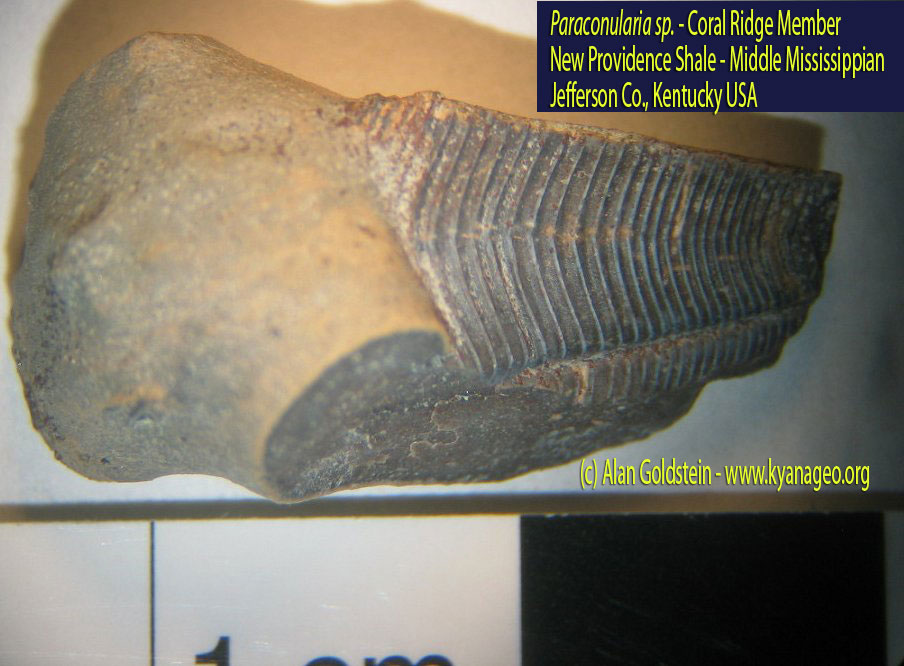
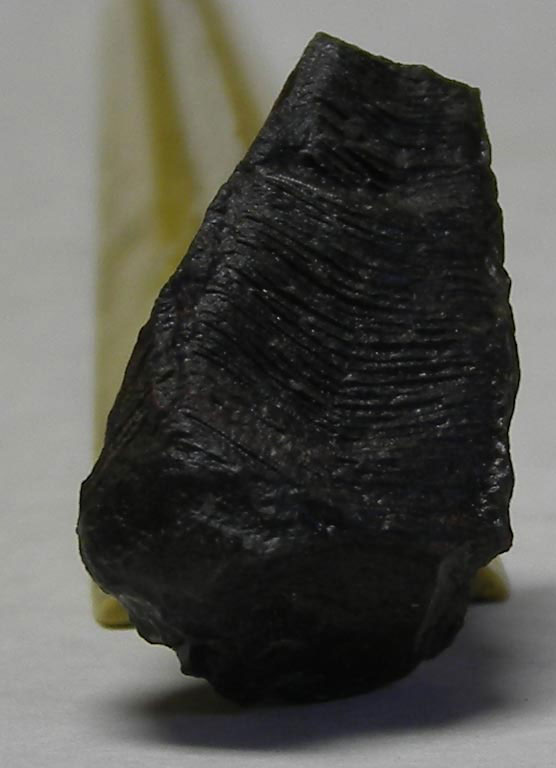
Here is an ancient sea creature I am trying to draw. It is called a Conularia and existed in the Mississippian Period. It is not known what it actually looked like some thought it might be some sort of jellyfish that floated around. Specimens have been found where the tip or apex had a stem on it. So it might have been like a crinoid with tentacles.

Check out this link at Harvard for more information about this creature.

The Louisville Fossils site also has an entry.


These creatures can might also be referred to as Paraconularia. You can find some more images of the Conularia on the KYANA Geological Society website:

http://www.kyanageo.org/Fossils/mississippian/other/Conularid_Coral_Ridge1.jpg

http://www.kyanageo.org/Fossils/mississippian/other/Conularid_in_nodule_Coral_Ridge.jpg

http://www.kyanageo.org/Fossils/mississippian/Corals/conularia.jpg

This link shows a nice specimen from Missouri.

Monday, October 20, 2008

Lake Cumberland, Kentucky

Over the weekend, I got to go camping at Lake Cumberland, Kentucky and study the geology of the lake. The dam is being repaired so the banks of the lake are revealed which also shows all the exposed rock. This area has a lot of exposed Mississippian period fossils which consists mostly of the animal called a crinoid.